Five questions in every dossier
Is ID described as necessary at account creation?
Can KYC be triggered before a payout?
What identity, address or payment evidence can be required?
Are different payment methods subject to different checks?
Is each claim supported by an attributable current policy?
How to read our evidence labels
A primary source specifically supports this point. It is not a statement that the casino is approved or safe.
A policy gives the operator discretion or imposes a qualifying limit. Outcomes can vary.
There is not enough attributable evidence to make the claim. Silence is not an exemption.
Why verification policy needs different criteria
General casino ratings may consider reliability, payment methods, games, transaction speed and player reviews. For a verification-focused analysis, the relevant questions concern licence evidence, identity checks, payment conditions and reported disputes. Game libraries and bonus amounts do not establish verification policy.
We do not present unnamed reviewer testing or 0–1-hour payouts as established facts without dated supporting records. Every operator is assessed against the same five verification questions, including an explicit unknown status when a term cannot be substantiated.
Editorial verification workflow
- Match the casino name to its actual operator domain and legal documents.
- Read registration, account, payout, privacy and AML/KYC terms, including locale variants.
- Record the current source URL, relevant clause and the date reviewed.
- Compare the source against regulator findings, especially ACMA when relevant.
- Write the narrowest defensible summary, with limitations and unresolved questions.
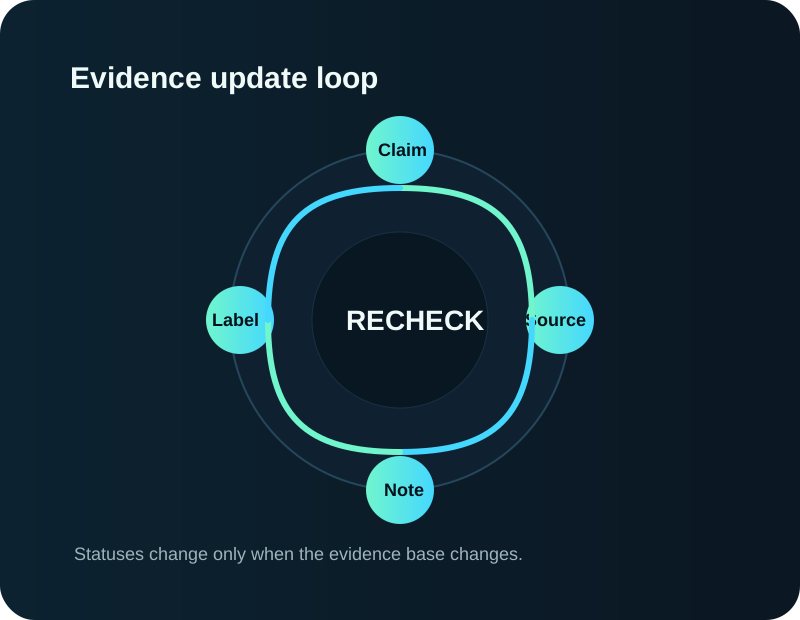
- Recheck when policies change or a discrepancy is reported.
How the evidence loop works
How a dossier moves from claim to limitation
Every page starts with the operator claim, then narrows it through clause extraction, limitation notes and linked source material.
What changes a status label?
A directly attributable operator policy or official public record clearly supports the point.
The operator reserves discretion or applies the rule only at certain thresholds or stages.
The source disappears, conflicts with other records or never actually proves the claim.
What this project does not claim
We do not claim to have opened accounts, deposited money, withdrawn winnings or tested verification systems. We do not label these casinos as legal for Australians, and a source-linked policy is not a safety certification. We do not award subjective casino ratings.
Some entries, such as Bof Casino, remain explicitly incomplete until the official operator policy can be authenticated.
Source corrections and updates
Research date: 15 October 2026. This initial release uses publicly accessible sources. Each dossier identifies its primary documents. Where a document becomes inaccessible or contradictory, the associated claim should be downgraded to “not confirmed” until rechecked.
Future releases can add a versioned evidence register and change log without changing page URLs.
Related verification question: Use the same evidence labels across each question. browse evidence · Australian regulation